
Your cart is currently empty!

Categories
Birth, Death, and Life in Between

“The problem with medicine and the institutions it has spawned for the care of the sick and the old is not that they have had an incorrect view of what makes life significant. The problem is that they have had almost no view at all. For more than half a century now, we have treated the trials of sickness, aging, and mortality as medical concerns.” —Atul Gawande
Everyone on this earth goes through the birth process, has a life to live, and then dies. It’s a span of years, sometimes short, sometimes much longer. Why are we here? Some say it is a surprising and singular event in the universe and when it’s over, that’s all there is. Others suggest that we came from divine origins and will return to heaven or some kind of life after death and we’re here to prepare for that eventuality.
The first two books celebrate birth and life, and the final one offers some perspective on dying, which is the most difficult to face and discuss.
 In her memoir Baby Catcher, Peggy Vincent tells about her journey from being a student nurse in pediatrics to eventually becoming a midwife. With humor and a delight in the miracle of birth, she shares her experiences of assisting nearly 3,000 women through the birthing process.
Favorite Quotes
“Then Zelda winked at me, and as she flashed her smile full of crooked teeth, I knew we were in it together, conspirators at a birth. An hour passed this way, and I smiled and nodded my head in rhythm to her Gospel chanting. And she was right. She didn’t fall off the bed. I was the one who did the falling as I fell under her spell. It was as though I’d stumbled into a piney woods revival tent and been transported by the spirit of a new religion. She made the process look like so much fun, I almost wanted to dance with her.
“Fortunately, those same swinging doors ushered other women like Marianna and Zelda into the delivery room. They came in huffing and puffing, and I gravitated toward them like steel to a magnet—women who knew what they wanted and didn’t want anyone messing with them.
“I lived for these occasional women, the ones who were different, who thrived on the challenge and the passion. The women who wanted to sigh and moan and deep-breathe through their labors, to move around in the bed, to squeeze my hands and look into my eyes.”
In 1971, pregnant with our first child, I expected labor to be a cakewalk. I’d been teaching natural childbirth classes for two years. I’d seen hundreds of deliveries. Talk about a setup. An hour after my own labor started, I realized I didn’t know diddly.
“Given the freedom offered by the birth centers that popped up everywhere, nurses, midwives, and the pregnant women themselves, rediscovered a wisdom more valid than any method we tried to superimpose on the natural process. Women’s bodies have near-perfect knowledge of childbirth; it’s when their brains get involved that things can go wrong.
“I’ve got a station wagon,” said Teri. She pushed Susie toward the purple-haired woman and turned to wrap up loose ends. Teri’s eyes snapped with the composure of a quarterback, and her capable hands hung ready at her sides. With her short, dark hair sticking out at funny angles from her head, she looked like a five-year old who’d been playing beauty parlor with her little sister. But I didn’t care what she looked like. She had Attitude and a station wagon. She was my new best friend. The world needs more people like her, I thought.”
 Gladys McGarey’s book, The Well-Lived Life, is full of wisdom and practices to experiment with, a 103-year old doctor shares her six secrets to health and happiness in every age of life.
Favorite Quotes
“First, take a moment to gently put your hand on your heart. Just rest it there, allowing your chest to feel the warmth of your hand, allowing your hand to feel the subtle movement of your heart beating. This is the deepest part of your being. This is where your soul lives. Whenever you fall out of alignment with life, move your hand back to your heart. This simple motion has immense power.
“Life itself is always in movement, so aligning with our life force means that we must always look for the flow within us. Though our bodies perform autonomic movement processes, it’s important for us to move consciously, as well.
“In addition, when we don’t release emotions and stuck energy, we compromise our lymphatic system, the organs and tissues that fight infection and rid the body of toxins. This is why bodywork is so important and why I myself prioritize receiving massage nearly every week in my stage of life.
“I understand anger to largely be an issue of the adrenals. Forgiveness allows life to move again, while grudges keep it stuck. Sometimes this means letting life move through us and around us without trying to stop it. Other times, it means actually getting up and moving ourselves”
Want to get suggestions on books to read every week?
Sign up for our FREE weekly newsletter providing some of Karen’s favorite books you might enjoy reading!
“I don’t know what mistakes you’ve made in the past but I’d like to suggest that you, too, mostly did the best you could with what you had at the time. If you find yourself living with regret, try to catch it and see what’s moving. Did things mostly turn out all right? If so, be grateful! Is there anything funny about it? If so, laugh! Have you learned anything new since then? If so, enjoy what you now know and express it however you can! Do whatever you can do to let your regret go—forgive yourself and, if necessary, ask for forgiveness from others—so you can move on with your life.”
 In his book, Being Mortal, Atul Gawande explains that medicine has transformed childbirth, injury, and disease from harrowing to manageable. Yet, how we help our loved ones and friends prepare for death is often an uncomfortable topic. In this book, the author explores the worst and best practices and what can make a difference.
Favorite Quotes
“In almost no [nursing home] does anyone sit down with you and try to figure out what living a life really means to you under the circumstances, let alone help you make a home where that life becomes possible
“I got better enough to realize how close I had come to losing my life, and I saw very differently that what mattered to me were other people in my life. As your horizons contract—when you see the future ahead of you as finite and uncertain—your focus shifts to the here and now, to everyday pleasures and the people closest to you.
“The soaring cost of health care has become the greatest threat to the long-term solvency of most advanced nations, and the incurable account for a lot of it.
“For a patient whose cancer proves fatal, though, the cost curve is U-shaped, rising toward the end—to an average of $94,000 during the last year of life with a metastatic breast cancer.
“Our medical system is excellent at trying to stave off death with $12,000-a-month chemotherapy, $4,000-a-day intensive care, $7,000-an-hour surgery.
“Almost all these patients had known, for some time, that they had a terminal condition. Yet they—along with their families and doctors—were unprepared for the final stage.
“In 2008, the national Coping with Cancer project published a study showing that terminally ill cancer patients who were put on a mechanical ventilator, given electrical defibrillation or chest compressions, or admitted, near death, to intensive care had a substantially worse quality of life in their last week than those who received no such interventions.
“In hospice, the initial visit is always tricky. A nurse has five seconds to make a patient like you and trust them. It’s in the whole way you present yourself. I do no come in saying, ‘I’m so sorry.’ Instead, it’s: ‘I’m the hospice nurse, and here’s what I have to offer you to make your life better. And I know we don’t have a lot of time to waste.’
“You’d think doctors would be well equipped to navigate the shoals here, but at least two things get in the way. First, our own views may be unrealistic. … Second, we often avoid voicing even these sentiments. But that doesn’t mean we are eager to make the choices ourselves. Instead, most often, we make no choice at all.
“Questions to ask: 1. Do you want to be resuscitated if your heart stops? 2. Do you want aggressive treatments such as intubation and mechanical ventilation? 3. Do you want antibiotics? 4. Do you want tube or intravenous feeding if you can’t eat on your own?
“We focus on laying out the facts and the options. But that’s a mistake, Block said. ‘A large part of the task is helping people negotiate the overwhelming anxiety—anxiety about death, anxiety about suffering, anxiety about loved ones, anxiety about finances.
“You’re trying to learn what’s most important to them under the circumstances. This process requires as much listening as talking. If you’re talking more than half the time, you’re talking too much. If time becomes short, you ask, ‘What is most important to you?’
“Bob Arnold, a palliative care physician explained that the mistake clinicians make in these situations it that they see their task as just supplying cognitive information—hard, cold facts and descriptions. They want to be Dr. Informative. But it’s the meaning behind the information that people are looking for more than the facts.
“Arnold had also recommended a strategy palliative care physicians use when they have to talk about bad news with people—they ‘ask, tell, ask.’ They ask what you want to hear, then they tell you, and then they ask what you understood.”
Conclusion
Most of us have a choice about how we will live, whether we will take this mortal experience for granted, or numb ourselves, or become the best version of ourselves. And at different ages, if we are observant, this question will arise again and again: “Why am I here?” And eventually, “How will I prepare for the end of life?”


 John-Roger and Peter McWilliams explore every concept related to overcoming the habit of negative thinking in their book, You Can’t Afford the Luxury of a Negative Thought.
 The Choice by Dr. Edith Eva Eger is an inspiringly-written memoir, and a gift: one of those stories that has the potential to leave you forever changed.
 In his book,
  In her book,
  In my book,
 The date Transformational Thinking (now updated in 2023 in Imagine Your Life, Discover Your Dreams, available on Amazon) came off the press signaled the fulfillment of a dream to bring the Life Creation Process into tangible book form after years of presenting and clarifying these life-planning concepts. It is an accumulation of much thought, experiences, questioning, writing, experimenting, refining of ideas, and then more rewriting.
 As I think back to that moment in 2004, I realize that I haven’t stopped learning about and refining the concepts I thought I had so clearly explained in that volume.
 Feel the Fear and Do It Anyway by Susan Jeffers helps individuals look at the underlying messages that keep them stuck in resistance language and change them into possibility thinking.
 My latest book, How to Make Communication Easier is now available on Amazon. It’s the last of the “how to” books I’ve written: How to Make Writing Easier and How to Make Financial Independence Easier. As an instructional writer, it’s been my intent to write books that are easy to read and where concepts are clearly explained.
 In her book, The Four-Fold Way, she explains that the Four-Chambered Heart is full, open, clear and strong. For vision to be 20:20 the heart must be firing on all chambers.
 Brené Brown is a researcher and a storyteller, a leading expert on shame, authenticity, and belonging. In her book, Gifts of Imperfection, she shares ten guideposts of wholehearted living—a way of engaging with the world from a place of worthiness.
 Doc Childre and Howard Martin, in their book, The HeartMath Solution, ask the following personal-evaluation questions. What is you could easily . . .
 Heart Minded


 In their book,
  In her book,
  In his book,

 I was a victim of what Michael Hyatt refers to as “the drift”—a metaphor for living without a plan. In his book,
 Some books expand my mind and open me to new ideas and ways of thinking. This one was suggested to me by one of my brothers.
  Other books surprise me with insights that change my attitude or my life and help me navigate through life’s ups and downs with more grace. In
  Penny Peirce, author of
 Every game, even the game of life, is composed of two parts, an outer game and an inner game. There are many books offering instructions about the outer aspects of living. Timothy Gallwey, in his book,
  A second surprising book about the mental game in everything is
  The third book that explores the mental game in everything is
 Begin Writing
 In
In 
 Beginning Steps
 financial situation is a disaster and how following four specific laws transformed his life.
 two fathers, a rich one and a poor one. Robert writes, “One was highly educated and intelligent, had a Ph.D. and continue his advanced studies, all on full financial scholarships. The other father never finished the eighth grade.
 I love books that create such a beautiful world that it’s heart breaking to leave it. This is what Juliet Marillier does in her fantasy series time and time again. These books are elegantly written based on fairy tales. The Sevenwaters series is based on the Seven Swans story. The first book is
  Another cleverly-written series is the Mercy Thompson books by Patricia Briggs. The first book in this series is Moon Called. Patricia has created an urban-fantasy world about a Volkswagen mechanic living in the Tri-Cities area of Washington. Mercy’s Native American heritage has gifted her with the ability to shape-shift into an unremarkable coyote.
 I especially enjoy books that are cleverly written with a surprising twist.
 In addition, they have a capacity for self-reflection, and “carry forward a positive vision of the future. They are comfortable with not knowing as they venture onto new life paths.
 Jennifer James, author of
  Next, we are becoming clearer about our creative abilities. Nudged by John Briggs and David Peat, authors of
  In addition, Adam Grant, author of
 The term, mental immunity is explored in
  In his book,
  Shefali Tsabary’s book is my all-time favorite parenting book.
 Nancy Kline’s book,
 In his best-selling book,
  David Whyte laments this in his book,
  When we’re not mindful and sometimes unclear about the next step, in her book,

 In my favorite,


 If you’re not sure where to start, order my book,
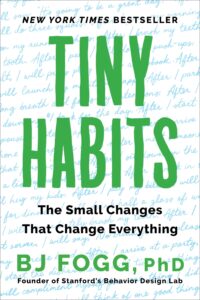
 This is an easier read with better spacing without a plethora of graphs and illustrations.
  Influencer – The New Science of Leading Change